Read the Bible in a Year

Each day, we'll post passages so that you can read the Bible in one year. This is part of The Colossians 13:16 Project, sponsored by Cove Presbyterian Church, 3404 Main Street, Weirton, West Virginia. You're invited to worship with us Sundays, at 11:00 a.m. or Saturdays, at 6:30 p.m. You may also want to consider joining one our adult Bible Studies: Thursdays at 12:00 noon and Sundays at 9:30 a.m. and 10:00 a.m. We also have a full range of programs for children. If you want more information about the church, check out the other blogs. And please feel free to leave any comments.

The Bible in a Year is a ministry of Cove Presbyterian Church. We need your support to keep posting. If you find it helpful, you can support this blog by your contributions. They may be sent to Cove Presbyterian Church, 3404 Main Street, Weirton, WV 26062. You can also use the PayPal link below:

Image result for paypal donate
Showing posts with label Stewart Udall. Show all posts

Monday, July 17, 2017

Bible Readings for July 17, 2017


Today our passages are 1 Chronicles 24:1–26:11; Romans 4:1-12; Psalm 13:1-6; and Proverbs 19:15-16. The readings are from the Contemporary English VersionIf you find these readings helpful, please consider sending an offering directly to Cove Presbyterian Church, 3404 Main Steet, Weirton, West Virginia or through PayPal by using the link below.

https://www.paypal.com/cgi-bin/webscr?cmd=_s-xclick&hosted_button_id=NX3WLYQG5864L

1 Chronicles 24-26:11 (Contemporary English Version)

1 Chronicles 24

David Assigns the Priests Their Duties
 1Aaron's descendants were then divided into work groups. Aaron had four sons: Nadab, Abihu, Eleazar, and Ithamar. 2But Nadab and Abihu died long before their father, without having any sons. That's why Eleazar and Ithamar served as priests.     3David divided Aaron's descendants into groups, according to their assigned work. Zadok, one of Eleazar's descendants, and Ahimelech, one of Ithamar's descendants, helped David.
    4Eleazar's descendants were divided into sixteen groups, and Ithamar's were divided into eight groups, because Eleazar's family included more family leaders. 5However, both families included temple officials and priests, and so to make sure the work was divided fairly, David asked God what to do. [a] 6As each group was assigned their duties, Shemaiah the son of Nethanel the Levite wrote down the name of the family leader in charge of that group. The witnesses were David and his officials, as well as Zadok the priest, Ahimelech the son of Abiathar, and the family leaders from the clans of the priests and the Levites.
    7-18Each group of priests went by the name of its family leader, and they were assigned their duties in the following order: Jehoiarib, Jedaiah, Harim, Seorim, Malchijah, Mijamin, Hakkoz, Abijah, Jeshua, Shecaniah, Eliashib, Jakim, Huppah, Jeshebeab, Bilgah, Immer, Hezir, Happizzez, Pethahiah, Jehezkel, Jachin, Gamul, Delaiah, Maaziah. 19These men were assigned their duties at the temple, just as the LORD God of Israel had commanded their ancestor Aaron.
   
The Rest of the Levites Are Assigned Their Duties
 20Here is a list of the other descendants of Levi:    Amram was the ancestor of Shubael and Jehdeiah.
    21Rehabiah was the ancestor of Isshiah, the oldest son in his family.
    22Izhar was the father of Shelomoth and the grandfather of Jahath.
    23Hebron had four sons, in the following order: Jeriah, Amariah, Jahaziel, and Jekameam.
    24Uzziel was the father of Micah and the grandfather of Shamir.
    25Isshiah, Micah's brother, was the father of Zechariah.
    26Merari was the father of Mahli, Mushi, and Jaaziah.
    27Jaaziah had three sons: Shoham, Zaccur, and Ibri. [b] 28-29Mahli was the father of Eleazar and Kish. Eleazar had no sons, but Kish was the father of Jerahmeel. 30Mushi had three sons: Mahli, Eder, and Jerimoth. These were the descendants of Levi, according to their clans. 31Each one was assigned his duties in the same way that their relatives the priests had been assigned their duties. David, Zadok, Ahimelech, and the family leaders of the priests and Levites were the witnesses.
   

1 Chronicles 25

David Assigns the Temple Musicians Their Duties
 1David and the temple officials chose the descendants of Asaph, Heman, and Jeduthun to be in charge of music. They were to praise the LORD by playing cymbals, harps and other stringed instruments. Here is a list of the musicians and their duties:     2Asaph's four sons, Zaccur, Joseph, Nethaniah, and Asarelah, were under the direction of their father and played music whenever the king told them to.
    3Jeduthun's six sons, Gedaliah, Zeri, Jeshaiah, Shimei, [c] Hashabiah, and Mattithiah, were under the direction of their father and played harps and sang praises to the LORD. 4Heman had fourteen sons: Bukkiah, Mattaniah, Uzziel, Shebuel, Jerimoth, Hananiah, Hanani, Eliathah, Giddalti, Romamtiezer, Joshbekashah, Mallothi, Hothir, Mahazioth. 5Heman was one of the king's prophets, and God honored Heman by giving him fourteen sons and three daughters. 6His sons were under his direction and played cymbals, harps, and other stringed instruments during times of worship at the temple.
   Asaph, Jeduthun, and Heman took their orders directly from the king.
    7There were two hundred eighty-eight of these men, and all of them were skilled musicians. 8David assigned them their duties by asking the LORD what he wanted. [d] Everyone was responsible for something, whether young or old, teacher or student. 9-31The musicians were divided into twenty-four groups of twelve, and each group went by the name of their family leader. They were assigned their duties in the following order: Joseph, Gedaliah, Zaccur, Zeri, Nethaniah, Bukkiah, Asarelah, Jeshaiah, Mattaniah, Shimei, Uzziel, Hashabiah, Shebuel, Mattithiah, Jerimoth, Hananiah, Joshbekashah, Hanani, Mallothi, Eliathah, Hothir, Giddalti, Mahazioth, and Romamtiezer.
   

1 Chronicles 26

The Temple Guards Are Assigned Their Duties
 1The temple guards were also divided into groups according to clans.    Meshelemiah son of Kore was from the Korah clan and was a descendant of Asaph. 2He had seven sons, who were born in the following order: Zechariah, Jediael, Zebadiah, Jathniel, 3Elam, Jehohanan, and Eliehoenai.
    4-5Obed-Edom had been blessed with eight sons: Shemaiah, Jehozabad, Joah, Sachar, Nethanel, Ammiel, Issachar, and Peullethai.
    6-7Shemaiah was the father of Othni, Rephael, Obed, Elzabad, Elihu, and Semachiah. They were all respected leaders in their clan. 8There were sixty-two descendants of Obed-Edom who were strong enough to be guards at the temple.
    9Eighteen descendants of Meshelemiah were chosen for this work.
    10-11Hosah, from the Merari clan, was the father of Shimri, Hilkiah, Tebaliah, and Zechariah. Hosah had made Shimri the family leader, even though he was not the oldest son. Thirteen men from Hosah's family were chosen to be temple guards.
   
Footnotes:
  1. 1 Chronicles 24:5 asked God what to do: The Hebrew text has "cast lots" (see the note at 6.65).
  2. 1 Chronicles 24:27 Ibri: One possible meaning for the difficult Hebrew text of verses 26,27.
  3. 1 Chronicles 25:3 Shimei: One Hebrew manuscript and two ancient translations; other Hebrew manuscripts do not have this name.
  4. 1 Chronicles 25:8 asking the LORD what he wanted: The Hebrew text has "casting lots" (see the note at 6.65).


Romans 4:1-12 (Contemporary English Version)

Romans 4

The Example of Abraham
 1Well then, what can we say about our ancestor Abraham? 2If he became acceptable to God because of what he did, then he would have something to brag about. But he would never be able to brag about it to God. 3The Scriptures say, "God accepted Abraham because Abraham had faith in him."     4Money paid to workers isn't a gift. It is something they earn by working. 5But you cannot make God accept you because of something you do. God accepts sinners only because they have faith in him. 6In the Scriptures David talks about the blessings that come to people who are acceptable to God, even though they don't do anything to deserve these blessings. David says,
    7"God blesses people
   whose sins are forgiven
   and whose evil deeds
   are forgotten.
    8The Lord blesses people
   whose sins are erased
   from his book."
    9Are these blessings meant for circumcised people or for those who are not circumcised? Well, the Scriptures say that God accepted Abraham because Abraham had faith in him. 10But when did this happen? Was it before or after Abraham was circumcised? Of course, it was before.
    11Abraham let himself be circumcised to show that he had been accepted because of his faith even before he was circumcised. This makes Abraham the father of all who are acceptable to God because of their faith, even though they are not circumcised. 12This also makes Abraham the father of everyone who is circumcised and has faith in God, as Abraham did before he was circumcised.


Psalm 13:1-6 (Contemporary English Version)

Psalm 13

(A psalm by David for the music leader.)
A Prayer for the LORD's Help
 1How much longer, LORD,    will you forget about me?
   Will it be forever?
   How long will you hide?
    2How long must I be confused
   and miserable all day?
   How long will my enemies
   keep beating me down?
    3Please listen, LORD God,
   and answer my prayers.
   Make my eyes sparkle again,
   or else I will fall
   into the sleep of death.
    4My enemies will say,
   "Now we've won!"
   They will be greatly pleased
   when I am defeated.
    5I trust your love,
   and I feel like celebrating
   because you rescued me.
    6You have been good to me, LORD,
   and I will sing about you.


Proverbs 19:15-16 (Contemporary English Version)

15If you are lazy
   and sleep your time away,
   you will starve.
    16Obey the Lord's teachings
   and you will live--
   disobey and you will die.


Verse of the Day

“[The Power of the Good News]I am proud of the good news! It is God's powerful way of saving all people who have faith, whether they are Jews or Gentiles.” - Romans 1:16
Today's passage is from the Contemporary English Version.

Stewart L Udall - 1960s.jpgThought for the Day

American politician and later, a federal government official, Stewart Udall wrote, “We have, I fear, confused power with greatness.”
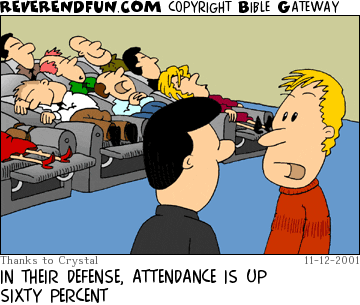

Image result for sleeping in churchA Joke for Today

A Sunday school teacher asked her little children, as they were on the way to church service,

"And why is it necessary to be quiet in church?"

One bright little girl replied, "Because people are sleeping."

Monday, June 6, 2016

Bible Readings for June 6, 2016


Today our passages are 1 Kings 1:1-53; Acts 4:1-37; Psalm 124:1-8; and Proverbs 16:24. The readings are from The Message by Eugene H. PetersonIf you find these readings helpful, please consider sending an offering directly to Cove Presbyterian Church, 3404 Main Street, Weirton, West Virginia or through PayPal.

1 Kings 1:1-53 (The Message)


1 Kings 1

David
 1-4King David grew old. The years had caught up with him. Even though they piled blankets on him, he couldn't keep warm. So his servants said to him, "We're going to get a young virgin for our master the king to be at his side and look after him; she'll get in bed with you and arouse our master the king." So they searched the country of Israel for the most ravishing girl they could find; they found Abishag the Shunammite and brought her to the king. The girl was stunningly beautiful; she stayed at his side and looked after the king, but the king did not have sex with her.  5-6 At this time Adonijah, whose mother was Haggith, puffed himself up saying, "I'm the next king!" He made quite a splash, with chariots and riders and fifty men to run ahead of him. His father had spoiled him rotten as a child, never once reprimanding him. Besides that, he was very good-looking and the next in line after Absalom.
 7-8 Adonijah talked with Joab son of Zeruiah and with Abiathar the priest, and they threw their weight on his side. But neither the priest Zadok, nor Benaiah son of Jehoiada, nor Nathan the prophet, nor Shimei and Rei, nor David's personal bodyguards supported Adonijah.
 9-10 Next Adonijah held a coronation feast, sacrificing sheep, cattle, and grain-fed heifers at the Stone of Zoheleth near the Rogel Spring. He invited all his brothers, the king's sons, and everyone in Judah who had position and influence—but he did not invite the prophet Nathan, Benaiah, the bodyguards, or his brother Solomon.
 11-14 Nathan went to Bathsheba, Solomon's mother, "Did you know that Adonijah, Haggith's son, has taken over as king, and our master David doesn't know a thing about it? Quickly now, let me tell you how you can save both your own life and Solomon's. Go immediately to King David. Speak up: 'Didn't you, my master the king, promise me, "Your son Solomon will be king after me and sit on my throne"? So why is Adonijah now king?' While you're there talking with the king, I'll come in and corroborate your story."
 15-16 Bathsheba went at once to the king in his palace bedroom. He was so old! Abishag was at his side making him comfortable. As Bathsheba bowed low, honoring the king, he said, "What do you want?"
 17-21 "My master," she said, "you promised me in God's name, 'Your son Solomon will be king after me and sit on my throne.' And now look what's happened—Adonijah has taken over as king, and my master the king doesn't even know it! He has thrown a huge coronation feast—cattle and grain-fed heifers and sheep—inviting all the king's sons, the priest Abiathar, and Joab head of the army. But your servant Solomon was not invited. My master the king, every eye in Israel is watching you to see what you'll do—to see who will sit on the throne of my master the king after him. If you fail to act, the moment you're buried my son Solomon and I are as good as dead."
 22-23 Abruptly, while she was telling the king all this, Nathan the prophet came in and was announced: "Nathan the prophet is here." He came before the king, honoring him by bowing deeply, his face touching the ground.
 24-27 "My master the king," Nathan began, "did you say, 'Adonijah shall be king after me and sit on my throne'? Because that's what's happening. He's thrown a huge coronation feast—cattle, grain-fed heifers, sheep—inviting all the king's sons, the army officers, and Abiathar the priest. They're having a grand time, eating and drinking and shouting, 'Long live King Adonijah!' But I wasn't invited, nor was the priest Zadok, nor Benaiah son of Jehoiada, nor your servant Solomon. Is this something that my master the king has done behind our backs, not telling your servants who you intended to be king after you?"
 28 King David took action: "Get Bathsheba back in here." She entered and stood before the king.
 29-30 The king solemnly promised, "As God lives, the God who delivered me from every kind of trouble, I'll do exactly what I promised in God's name, the God of Israel: Your son Solomon will be king after me and take my place on the throne. And I'll make sure it happens this very day."
 31 Bathsheba bowed low, her face to the ground. Kneeling in reverence before the king she said, "Oh, may my master, King David, live forever!"
 32 King David said, "Call Zadok the priest, Nathan the prophet, and Benaiah son of Jehoiada." They came to the king.
 33-35 Then he ordered, "Gather my servants, then mount my son Solomon on my royal mule and lead him in procession down to Gihon. When you get there, Zadok the priest and Nathan the prophet will anoint him king over Israel. Then blow the ram's horn trumpet and shout, 'Long live King Solomon!' You will then accompany him as he enters and takes his place on my throne, succeeding me as king. I have named him ruler over Israel and Judah."
 36-37 Benaiah son of Jehoiada backed the king: "Yes! And may God, the God of my master the king, confirm it! Just as God has been with my master the king, may he also be with Solomon and make his rule even greater than that of my master King David!"
 38-40 Then Zadok the priest, Nathan the prophet, Benaiah son of Jehoiada, and the king's personal bodyguard (the Kerethites and Pelethites) went down, mounted Solomon on King David's mule, and paraded with him to Gihon. Zadok the priest brought a flask of oil from the sanctuary and anointed Solomon. They blew the ram's horn trumpet and everyone shouted, "Long live King Solomon!" Everyone joined the fanfare, the band playing and the people singing, the very earth reverberating to the sound.
 41 Adonijah and his retinue of guests were just finishing their "coronation" feast when they heard it. When Joab heard the blast of the ram's horn trumpet he said, "What's going on here? What's all this uproar?"
 42 Suddenly, in the midst of the questioning, Jonathan son of Abiathar the priest, showed up. Adonijah said, "Welcome! A brave and good man like you must have good news."
 43-48 But Jonathan answered, "Hardly! Our master King David has just made Solomon king! And the king has surrounded him with Zadok the priest, Nathan the prophet, Benaiah son of Jehoiada, with the Kerethites and Pelethites; and they've mounted Solomon on the royal mule. Zadok the priest and Nathan the prophet have anointed him king at Gihon and the parade is headed up this way singing—a great fanfare! The city is rocking! That's what you're hearing. Here's the crowning touch—Solomon is seated on the throne of the kingdom! And that's not all: The king's servants have come to give their blessing to our master King David saying, 'God make Solomon's name even more honored than yours, and make his rule greater than yours!' On his deathbed the king worshiped God and prayed, 'Blessed be God, Israel's God, who has provided a successor to my throne, and I've lived to see it!'"
 49-50 Panicked, Adonijah's guests got out of there, scattering every which way. But Adonijah himself, afraid for his life because of Solomon, fled to the sanctuary and grabbed the horns of the Altar.
 51 Solomon was told, "Adonijah, fearful of King Solomon, has taken sanctuary and seized the horns of the Altar and is saying, 'I'm not leaving until King Solomon promises that he won't kill me.'"
 52-53 Solomon then said, "If he proves to be a man of honor, not a hair of his head will be hurt; but if there is evil in him, he'll die." Solomon summoned him and they brought him from the Altar. Adonijah came and bowed down, honoring the king. Solomon dismissed him, "Go home."


Acts 4:1-37 (The Message)

Acts 4

Nothing to Hide
 1-4While Peter and John were addressing the people, the priests, the chief of the Temple police, and some Sadducees came up, indignant that these upstart apostles were instructing the people and proclaiming that the resurrection from the dead had taken place in Jesus. They arrested them and threw them in jail until morning, for by now it was late in the evening. But many of those who listened had already believed the Message—in round numbers about five thousand!  5-7The next day a meeting was called in Jerusalem. The rulers, religious leaders, religion scholars, Annas the Chief Priest, Caiaphas, John, Alexander—everybody who was anybody was there. They stood Peter and John in the middle of the room and grilled them: "Who put you in charge here? What business do you have doing this?"
 8-12With that, Peter, full of the Holy Spirit, let loose: "Rulers and leaders of the people, if we have been brought to trial today for helping a sick man, put under investigation regarding this healing, I'll be completely frank with you—we have nothing to hide. By the name of Jesus Christ of Nazareth, the One you killed on a cross, the One God raised from the dead, by means of his name this man stands before you healthy and whole. Jesus is 'the stone you masons threw out, which is now the cornerstone.' Salvation comes no other way; no other name has been or will be given to us by which we can be saved, only this one."
 13-14They couldn't take their eyes off them—Peter and John standing there so confident, so sure of themselves! Their fascination deepened when they realized these two were laymen with no training in Scripture or formal education. They recognized them as companions of Jesus, but with the man right before them, seeing him standing there so upright—so healed!—what could they say against that?
 15-17They sent them out of the room so they could work out a plan. They talked it over: "What can we do with these men? By now it's known all over town that a miracle has occurred, and that they are behind it. There is no way we can refute that. But so that it doesn't go any further, let's silence them with threats so they won't dare to use Jesus' name ever again with anyone."
 18-20They called them back and warned them that they were on no account ever again to speak or teach in the name of Jesus. But Peter and John spoke right back, "Whether it's right in God's eyes to listen to you rather than to God, you decide. As for us, there's no question—we can't keep quiet about what we've seen and heard."
 21-22The religious leaders renewed their threats, but then released them. They couldn't come up with a charge that would stick, that would keep them in jail. The people wouldn't have stood for it—they were all praising God over what had happened. The man who had been miraculously healed was over forty years old.
One Heart, One Mind
 23-26As soon as Peter and John were let go, they went to their friends and told them what the high priests and religious leaders had said. Hearing the report, they lifted their voices in a wonderful harmony in prayer: "Strong God, you made heaven and earth and sea and everything in them. By the Holy Spirit you spoke through the mouth of your servant and our father, David:

   Why the big noise, nations?
   Why the mean plots, peoples?
   Earth's leaders push for position,
   Potentates meet for summit talks,
   The God-deniers, the Messiah-defiers!
 27-28"For in fact they did meet—Herod and Pontius Pilate with nations and peoples, even Israel itself!—met in this very city to plot against your holy Son Jesus, the One you made Messiah, to carry out the plans you long ago set in motion.
 29-30"And now they're at it again! Take care of their threats and give your servants fearless confidence in preaching your Message, as you stretch out your hand to us in healings and miracles and wonders done in the name of your holy servant Jesus."
 31While they were praying, the place where they were meeting trembled and shook. They were all filled with the Holy Spirit and continued to speak God's Word with fearless confidence.
 32-33The whole congregation of believers was united as one—one heart, one mind! They didn't even claim ownership of their own possessions. No one said, "That's mine; you can't have it." They shared everything. The apostles gave powerful witness to the resurrection of the Master Jesus, and grace was on all of them.
 34-35And so it turned out that not a person among them was needy. Those who owned fields or houses sold them and brought the price of the sale to the apostles and made an offering of it. The apostles then distributed it according to each person's need.
 36-37Joseph, called by the apostles "Barnabas" (which means "Son of Comfort"), a Levite born in Cyprus, sold a field that he owned, brought the money, and made an offering of it to the apostles.


Psalm 124:1-8 (The Message)

Psalm 124

A Pilgrim Song of David
 1-5 If God hadn't been for us —all together now, Israel, sing out!—
   If God hadn't been for us
      when everyone went against us,
   We would have been swallowed alive
      by their violent anger,
   Swept away by the flood of rage,
      drowned in the torrent;
   We would have lost our lives
      in the wild, raging water.

 6 Oh, blessed be God!
      He didn't go off and leave us.
   He didn't abandon us defenseless,
      helpless as a rabbit in a pack of snarling dogs.

 7 We've flown free from their fangs,
      free of their traps, free as a bird.
   Their grip is broken;
      we're free as a bird in flight.

 8 God's strong name is our help,
      the same God who made heaven and earth.


Proverbs 16:24 (The Message)


 24 Gracious speech is like clover honey—
   good taste to the soul, quick energy for the body.


Verse of the Day
“and that Christ will live in your hearts because of your faith. Stand firm and be deeply rooted in his love. I pray that you and all of God's people will understand what is called wide or long or high or deep. I want you to know all about Christ's love, although it is too wonderful to be measured. Then your lives will be filled with all that God is.” - Ephesians 3:17-19
Today's passage is from the Contemporary English Version.

 
Stewart L Udall - 1960s.jpg
Thought for the Day
American politician and later, a federal government official, Stewart Udall wrote, “We have, I fear, confused power with greatness.”