

Today our passages are Judges
7:1–8:17; Luke 23:13-43; Psalm 97:1–98:9; and Proverbs 14:7-8. The readings are
the Contemporary English
Version.
Judges 7-8:17 (Contemporary English Version)
Judges 7
1Early the next morning, Gideon and his army got up and moved their camp to Fear Spring. [a] The Midianite camp was to the north, in the valley at the foot of Moreh Hill. [b] 2The LORD said, " Gideon, your army is too big. I can't let you win with this many soldiers. The Israelites would think that they had won the battle all by themselves and that I didn't have anything to do with it.3So call your troops together and tell them that anyone who is really afraid can leave Mount Gilead [c] and go home." Twenty-two thousand men returned home, leaving Gideon with only ten thousand soldiers.
4" Gideon," the LORD said, " you still have too many soldiers. Take them down to the spring and I'll test them. I'll tell you which ones can go along with you and which ones must go back home."
5When Gideon led his army down to the spring, the LORD told him, " Watch how each man gets a drink of water. Then divide them into two groups--those who lap the water like a dog and those who kneel down to drink."
6Three hundred men scooped up water in their hands and lapped it, and the rest knelt to get a drink.
7The LORD said, " Gideon, your army will be made up of everyone who lapped the water from their hands. Send the others home. I'm going to rescue Israel by helping you and your army of three hundred defeat the Midianites."
8Then Gideon gave these orders, " You three hundred men stay here. The rest of you may go home, but leave your food and trumpets with us."
Gideon's army camp was on top of a hill overlooking the Midianite camp in the valley.
9That night, the LORD said to Gideon. " Get up! Attack the Midianite camp. I am going to let you defeat them,
10but if you're still afraid, you and your servant Purah should sneak down to their camp.
11When you hear what the Midianites are saying, you'll be brave enough to attack."
Gideon and Purah worked their way to the edge of the enemy camp, where soldiers were on guard duty.
12The camp was huge. The Midianites, Amalekites, and other eastern nations covered the valley like a swarm of locusts. [d] And it would be easier to count the grains of sand on a beach than to count their camels.
13Gideon overheard one enemy guard telling another, " I had a dream about a flat [e] loaf of barley bread that came tumbling into our camp. It hit the headquarters tent, [f] and the tent flipped over and fell down."
14The other soldier answered, " Your dream must have been about Gideon, the Israelite commander. It means God will let him and his army defeat the Midianite army and everyone else in our camp."
15As soon as Gideon heard about the dream and what it meant, he bowed down to praise God. Then he went back to the Israelite camp and shouted, " Let's go! The LORD is going to let us defeat the Midianite army."
16Gideon divided his little army into three groups of one hundred men, and he gave each soldier a trumpet and a large clay jar with a burning torch inside.
17-18Gideon said, " When we get to the enemy camp, spread out and surround it. Then wait for me to blow a signal on my trumpet. As soon as you hear it, blow your trumpets and shout, `Fight for the LORD! Fight for Gideon!' "
19Gideon and his group reached the edge of the enemy camp a few hours after dark, just after the new guards had come on duty. [g] Gideon and his soldiers blew their trumpets and smashed the clay jars that were hiding the torches.
20The rest of Gideon's soldiers blew the trumpets they were holding in their right hands. Then they smashed the jars and held the burning torches in their left hands. Everyone shouted, " Fight with your swords for the LORD and for Gideon!"
21The enemy soldiers started yelling and tried to run away. Gideon's troops stayed in their positions surrounding the camp
22and blew their trumpets again. As they did, the LORD made the enemy soldiers pull out their swords and start fighting each other.
The enemy army tried to escape from the camp. They ran to Acacia Tree Town, toward Zeredah, [h] and as far as the edge of the land that belonged to the town of Abel-Meholah near Tabbath. [i]
23Gideon sent word for more Israelite soldiers to come from the tribes of Naphtali, Asher, and both halves of Manasseh [j] to help fight the Midianites.
24He also sent messengers to tell all the men who lived in the hill country of Ephraim, " Come and help us fight the Midianites! Put guards at every spring, stream, and well, as far as Beth-Barah before the Midianites can get to them. And guard the Jordan River." Troops from Ephraim did exactly what Gideon had asked,
25and they even helped chase the Midianites on the east side of the Jordan River. These troops captured Raven and Wolf, [k] the two Midianite leaders. They killed Raven at a large rock that has come to be known as Raven Rock, and they killed Wolf near a wine-pit that has come to be called Wolf Wine-Pit. [l] The men of Ephraim brought the heads of the two Midianite leaders to Gideon.
Judges 8
1Judges 8
1But the men were really upset with Gideon and complained, " When you went to war with Midian, you didn't ask us to help! Why did you treat us like that?" 2Gideon answered:Don't be upset! Even though you came later, you were able to do much more than I did. It's just like the grape harvest: The grapes your tribe doesn't even bother to pick are better than the best grapes my family can grow.
3Besides, God chose you to capture Raven and Wolf. I didn't do a thing compared to you.
By the time Gideon had finished talking, the men of Ephraim had calmed down and were no longer angry at him.
Gideon Finishes Destroying the Midianite Army
4After Gideon and his three hundred troops had chased the Midianites as far as the Jordan River, they were exhausted. 5The town of Succoth was nearby, so he went there and asked, " Please give my troops some food. They are worn out, but we have to keep chasing Zebah and Zalmunna, the two Midianite kings."6The town leaders of Succoth answered, " Why should we feed your army? We don't know if you really will defeat Zebah and Zalmunna."
7" Just wait!" Gideon said. " After the LORD helps me defeat them, I'm coming back here. I'll make a whip out of thorns and rip the flesh from your bones."
8After leaving Succoth, Gideon went to Penuel and asked the leaders there for some food. But he got the same answer as he had gotten at Succoth.
9" I'll come back safe and sound," Gideon said, " but when I do, I'm going to tear down your tower!" [m]
10Zebah and Zalmunna were in Karkor [n] with an army of fifteen thousand troops. They were all that was left of the army of the eastern nations, because one hundred twenty thousand of their warriors had been killed in the battle.
11Gideon reached the enemy camp by going east along Nomad [o] Road past Nobah and Jogbehah. He made a surprise attack,
12and the enemy panicked. Zebah and Zalmunna tried to escape, but Gideon chased and captured them.
13After the battle, Gideon set out for home. As he was going through Heres Pass,
14he caught a young man who lived in Succoth. Gideon asked him who the town officials of Succoth were, and the young man wrote down seventy-seven names.
15Gideon went to the town officials and said, " Here are Zebah and Zalmunna. Remember how you made fun of me? You said, `We don't know if you really will defeat those two Midianite kings. So why should we feed your worn-out army?' "
16Gideon made a whip from thorn plants and used it to beat the town officials.
17Afterwards he went to Penuel, where he tore down the tower and killed all the town officials [p] there.
Footnotes:
- Judges 7:1 Fear Spring: Or " Harod Spring."
- Judges 7:1 Moreh Hill: About 5 miles north of Fear Spring.
- Judges 7:3 Mount Gilead: Usually " Gilead" refers to an area east of the Jordan River, but in this verse it refers to a place near Jezreel Valley west of the Jordan.
- Judges 7:12 locusts: See the note at 6.4,5.
- Judges 7:13 flat: Or " moldy."
- Judges 7:13 the headquarters tent: Or " a tent."
- Judges 7:19 a few hours after dark, just. . . duty: The Hebrew text has " at the beginning of the second watch, just. . . duty." The night was divided into three periods called " watches," each about four hours long, and different guards would come on duty at the beginning of each watch. The first watch began at sunset, so the beginning of the second watch would have been shortly after 10:00 (P.M.)
- Judges 7:22 Zeredah: Some Hebrew manuscripts; most Hebrew manuscripts " Zererah" ; these may be different names for the town of Zarethan in the Jordan River valley.
- Judges 7:22 Acacia Tree Town. . . Zeredah. . . Abel-Meholah near Tabbath: These were places east of the Jordan River.
- Judges 7:23 both halves of Manasseh: Half of Manasseh lived east of the Jordan River, and the other half lived on the west.
- Judges 7:25 Raven and Wolf: Or " Oreb and Zeeb."
- Judges 7:25 Raven Rock. . . Wolf Wine-Pit: Or " Oreb Rock. . . Zeeb Wine-Pit."
- Judges 8:9 tower: Towers were often part of a town wall.
- Judges 8:10 Karkor: A little over 100 miles east of the Dead Sea.
- Judges 8:11 Nomad: A person who lives in a tent and moves from place to place.
- Judges 8:17 all. . . officials: Or " every man in town."
Luke 23:13-43 (Contemporary English Version)
The Death Sentence
(Matthew 27.15-26; Mark 15.6-15; John 18.39--19.16)
13Pilate called together the chief priests, the leaders, and the people. 14He told them, "You brought Jesus to me and said he was a troublemaker. But I have questioned him here in front of you, and I have not found him guilty of anything that you say he has done. 15Herod didn't find him guilty either and sent him back. This man doesn't deserve to be put to death! 16-17I will just have him beaten with a whip and set free." [a] 18But the whole crowd shouted, "Kill Jesus! Give us Barabbas!" 19Now Barabbas was in jail because he had started a riot in the city and had murdered someone. 20Pilate wanted to set Jesus free, so he spoke again to the crowds. 21But they kept shouting, "Nail him to a cross! Nail him to a cross!"22Pilate spoke to them a third time, "But what crime has he done? I have not found him guilty of anything for which he should be put to death. I will have him beaten with a whip and set free."
23The people kept on shouting as loud as they could for Jesus to be put to death. 24Finally, Pilate gave in. 25He freed the man who was in jail for rioting and murder, because he was the one the crowd wanted to be set free. Then Pilate handed Jesus over for them to do what they wanted with him.
Jesus Is Nailed to a Cross
(Matthew 27.31-44; Mark 15.21-32; John 19.17-27)
26As Jesus was being led away, some soldiers grabbed hold of a man from Cyrene named Simon. He was coming in from the fields, but they put the cross on him and made him carry it behind Jesus. 27A large crowd was following Jesus, and in the crowd a lot of women were crying and weeping for him. 28Jesus turned to the women and said:Women of Jerusalem, don't cry for me! Cry for yourselves and for your children. 29Someday people will say, "Women who never had children are really fortunate!" 30At that time everyone will say to the mountains, "Fall on us!" They will say to the hills, "Hide us!" 31If this can happen when the wood is green, what do you think will happen when it is dry? [b] 32Two criminals were led out to be put to death with Jesus. 33When the soldiers came to the place called "The Skull," [c] they nailed Jesus to a cross. They also nailed the two criminals to crosses, one on each side of Jesus. 34-35Jesus said, "Father, forgive these people! They don't know what they're doing." [d] While the crowd stood there watching Jesus, the soldiers gambled for his clothes. The leaders insulted him by saying, "He saved others. Now he should save himself, if he really is God's chosen Messiah!"
36The soldiers made fun of Jesus and brought him some wine. 37They said, "If you are the king of the Jews, save yourself!"
38Above him was a sign that said, "This is the King of the Jews."
39One of the criminals hanging there also insulted Jesus by saying, "Aren't you the Messiah? Save yourself and save us!"
40But the other criminal told the first one off, "Don't you fear God? Aren't you getting the same punishment as this man? 41We got what was coming to us, but he didn't do anything wrong." 42Then he said to Jesus, "Remember me when you come into power!"
43Jesus replied, "I promise that today you will be with me in paradise." [e]
Footnotes:
- Luke 23:16 set free: Some manuscripts add, " Pilate said this, because at every Passover he was supposed to set one prisoner free for the Jewish people."
- Luke 23:31 If this can happen when the wood is green, what do you think will happen when it is dry: This saying probably means, " If this can happen to an innocent person, what do you think will happen to one who is guilty?"
- Luke 23:33 " The Skull" : The place was probably given this name because it was near a large rock in the shape of a human skull.
- Luke 23:34 Jesus said, " Father, forgive these people! They don't know what they're doing." : These words are not in some manuscripts.
- Luke 23:43 paradise: In the Greek translation of the Old Testament, this word is used for the Garden of Eden. In New Testament times it was sometimes used for the place where God's people are happy and at rest, as they wait for the final judgment.
Psalm 97-98:9 (Contemporary English Version)
Psalm 97
The LORD Brings Justice
1The LORD is King! Tell the earth to celebrateand all islands to shout.
2Dark clouds surround him,
and his throne is supported
by justice and fairness.
3Fire leaps from his throne,
destroying his enemies,
4and his lightning is so bright
that the earth sees it
and trembles.
5Mountains melt away like wax
in the presence of the LORD
of all the earth.
6The heavens announce,
"The LORD brings justice!"
Everyone sees God's glory.
7Those who brag about
the useless idols they worship
are terribly ashamed,
and all the false gods
bow down to the LORD.
8When the people of Zion
and of the towns of Judah
hear that God brings justice,
they will celebrate.
9The LORD rules the whole earth,
and he is more glorious
than all the false gods.
10Love the LORD
and hate evil!
God protects his loyal people
and rescues them
from violence.
11If you obey and do right,
a light will show you the way
and fill you with happiness.
12You are the LORD's people!
So celebrate and praise
the only God.
Psalm 98
The LORD Works Miracles
1Sing a new song to the LORD! He has worked miracles,and with his own powerful arm,
he has won the victory.
2The LORD has shown the nations
that he has the power to save
and to bring justice.
3God has been faithful
in his love for Israel,
and his saving power is seen
everywhere on earth.
4Tell everyone on this earth
to sing happy songs
in praise of the LORD.
5Make music for him on harps.
Play beautiful melodies!
6Sound the trumpets and horns
and celebrate with joyful songs
for our LORD and King!
7Command the ocean to roar
with all of its creatures,
and the earth to shout
with all of its people.
8Order the rivers
to clap their hands,
and all of the hills
to sing together.
9Let them worship the LORD!
He is coming to judge
everyone on the earth,
and he will be honest
and fair.
Proverbs 14:7-8 (Contemporary English Version)
7Stay away from fools,
or you won't learn a thing.
8Wise people have enough sense
to find their way,
but stupid fools get lost.
Verse of the Day
“The Son of Man came to look for and to save people who are lost.” - Luke 19:10
or you won't learn a thing.
8Wise people have enough sense
to find their way,
but stupid fools get lost.
Verse of the Day
“The Son of Man came to look for and to save people who are lost.” - Luke 19:10
Today's passage is from the Contemporary
English Version.
Thought
for the Day
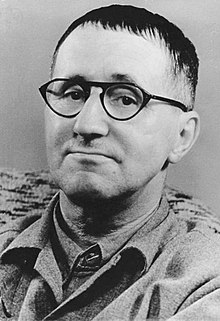
German poet, playwright, and theatre director, Bertolt Brecht wrote,
“Because things are the way they are, things will not stay the way they
are.”


